


STORIES WE THINK YOU'LL LIKE


2025 Microsoft Inclusion Changemaker Partner of the Year
Valorem Reply is proud to announce that we have been recognized as winner of 2025 Microsoft Inclusion Changemaker Partner of the Year Award
Read More
Popular change management models, like those developed by Prosci or the Change Management Institute (CMI), assume they’re talking to executive leadership instead of the people more typically involved in leading and growing change capability. They can also be weighed down by overly detailed, idealized versions of reality and an oversimplification of the process that makes the execution of the model complex. To make models actionable, they need a more practical approach.
If you have children (or spent some time in medicine), you are probably familiar with growth charts. These are the graphs that show percentile curves illustrating the average distribution of features among children by age. Things like head circumference, weight, and height are great examples. Parents and medical professionals will take all these measurements of a child and start to make comparisons relative to the national average, which can be tracked over time. Effective growth chart tracking can help parents make informed decisions about when and what interventions might make sense to continue healthy development.
Business maturity models operate under the same basic premise. Topic experts combine past experiences and best practices into an average approximation of what happens at each point on a maturity curve. Users of the maturity model can then compare themselves or their organization to the average to understand what interventions make the most sense for continuing their maturity development.
Is there a demand for maturity models?
Thinking about maturity models in this way helps understand why making models is very popular with subject matter experts. They have a chance to offer a clear point of view about how their area of expertise works, which presents an opportunity to simplify, visualize, and contextualize that knowledge to share with others. Unfortunately for the experts, that simplification can sometimes make it difficult for users to put them into actual practice. Unlike the child development growth chart, these models usually do not draw clear lines between where we are today, where we want to be, and how we get there.
Popular change management models, like those developed by Prosci or the Change Management Institute (CMI), assume they’re talking to executive leadership instead of the people more typically involved in leading and growing change capability. They can also be weighed down by overly detailed, idealized versions of reality and an oversimplification of the process that makes the execution of the model complex. To make models actionable, they need a more practical approach.
Prosci’s Five Levels of Change Management Maturity
Prosci organizes its maturity model into five levels (ad hoc or absent – isolated projects – multiple projects – organizational standards – organizational competency), ranging from non-existent to embedded in every part of the business. As organizations increase in maturity level, they further integrate change management into the business based on project profitability and responsiveness.
The world would probably be a better place if it worked like the Prosci maturity model where good ideas consistently produce positive results and naturally win over people with authority however, that is not typically how change management advances. Instead, change is usually led by a vocal sponsor or change evangelist who pushes for increased resources and company focus on change management. This growth happens in fits and starts and almost never advances uniformly across a company. It is a phenomenon we witness over and over again.
Prosci’s model lacks a clear plan of action. How do companies advance from one level to another? What are the tactical and strategic steps that need to take place? Without clear signs of how to advance as a company or clear priorities to focus on, the model feels like an idealistic goal rather than a practical maturity model you can use to improve your organization’s change maturity.
CMI’s Organizational Change Maturity Model
The other most commonly known model is from CMI. CMI organizes its maturity model into five levels (initial – repeatable – defined – managed – optimized) across three categories (strategic change leadership – business change readiness – project change management) of change. Organizations can improve their maturity model across the three change categories by increasing structure and embedding change into how each category conducts business.
Like Prosci, CMI describes change maturity without the human factors or inconsistent progression that often exists in real-world organizations. Unlike Prosci, CMI focuses on the minutiae of each level from a change management tooling and standards perspective. Descriptions of heat maps, board reporting, and change portfolios excite the change management enthusiasts, but though nice- to- have, they are not must-haves for change maturity. By focusing on this level of detail, CMI has missed describing something accessible and actionable for most consumers of these types of maturity models. Is the heat map really a defining feature of a level three organization over a level two organization?
Filling in the Gaps
Valorem Reply’s organizational change maturity model is about understanding where you are today, acknowledging where you want to go next, and offering clear pathways to improving change capacity and knowledge at your organization. This model recognizes that change maturity often does not develop equally across an organization and that unique struggles typically occur in each phase. A significant focus of the model is to capture the feel of each stage for someone pushing change growth while offering concrete objectives and guidance toward reaching the next level.
Valorem Reply’s Change Maturity Model
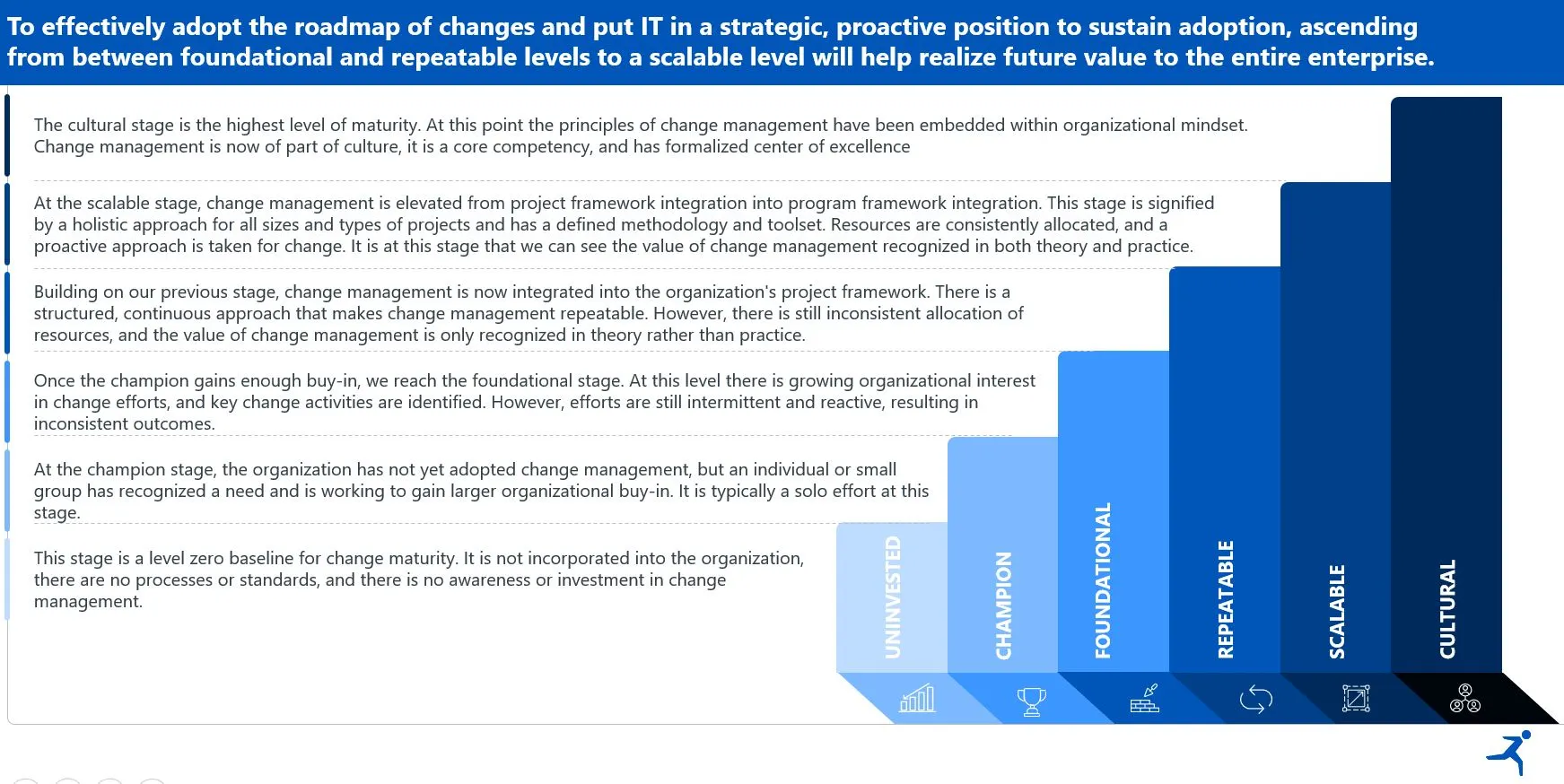 Valorem Reply Change Maturity Model
Uninvested
Everyone starts here. Investing in change management at any level is a choice, and some organizations are not ready for that investment. The number of companies in this stage has rapidly shrunk over the last ten years but still represents a significant number of companies.
Champion
Change maturity is often a personal journey. As you may have already seen, change often starts with one person. Therefore, it only takes one person caring enough about change management to move an organization from uninvested to champion.
Foundational
When a champion gathers sufficient momentum and buy-in, the organization can begin to experiment with change management. Several key change management activities may be identified and enter practice. Efforts are usually intermittent and primarily reactive to problems that arise, resulting in inconsistent project success. Individual successes where people learn about the value of change management will be more common.
Repeatable
Individual successes accumulate over time and tend to reinforce each other. Organizations in this phase tend to have enough people and portions of the business asking for change management that it becomes necessary to offer structured approaches and frameworks. This is often the point in time where companies seek out certification and expertise from groups like Prosci. The overall value change management brings to the business is not always clear to all stakeholders which can lead to insufficient resource allocation to meet company needs and make it challenging for organizations to transition to the next stage.
Scalable
Recognition of the need to grow change capacity to meet change needs is a critical characteristic of this phase. With increased resource allocation typically comes integration into a program management framework that allows for change management to become proactive. Methodologies are refined and advanced change toolsets are acquired or built.
Cultural
With recognition and investment across an organization, leaders start to ask questions about where else can change management and employee experience considerations be embedded, leading to new opportunities to embed best practices. Change expertise extends outside of the change management experts to leadership, sponsors, and champions to the point that change is a core competency of the organization. This new mindset becomes cultural in its execution and involvement.
A Final Note
Maturity models are ultimately useful because they challenge how people think about the world and offer new points of view. Our change management team recognized a need for a new model because of the lack of focus in current popular models on the journey individuals and companies often take on their road to change success. The path forward is not always clear, meaning people struggle unnecessarily.
Whether that’s for an informal discussion, a structured knowledge transfer, or a paid engagement, Valorem Reply Organizational Change Management would like to help you build a better, healthier change practice every day.
Valorem Reply specializes in not just finding the right technology for your unique needs and environment, but also integrating the people and process change needed to ensure success and maximum return on digital investments. If you are considering new solutions or processes for your frontline staff and want to learn more about what a change management journey might look like for you, email marketing.valorem@reply.com to schedule a consultation with one of our change management experts
FAQs
What is an organizational maturity model, and why do organizations need one?


Organizational maturity models benchmark your current change management capability against industry standards and best practices. They provide clear visibility into where you stand, identify gaps, and establish actionable pathways for improving organizational change capacity and competency systematically.
What are the main differences between Prosci and CMI maturity models?
Prosci organizes five levels around business integration (ad hoc to organizational competency), assuming an executive leadership context. CMI structures five levels across three categories (strategic leadership, readiness, project management) with a detailed tooling focus. Both lack clear tactical pathways for advancement and human factor recognition.
What are the six stages of Valorem Reply's change maturity model?
The six stages progress from Uninvested (no investment) to Champion (one person drives change) to Foundational (experimentation) to Repeatable (structured approaches) to Scalable (proactive growth) to Cultural (embedded competency). Each stage recognizes realistic organizational progression patterns and unique challenges.
How does an organization advance from one maturity level to the next?
Advancement requires clear objectives, concrete guidance, and recognition of unique struggles at each phase. Organizations need sufficient resource allocation, stakeholder buy-in, integration into program management, and intentional embedding of change practices into how teams conduct business at each stage.
Why do popular maturity models fail to drive organizational change?
Popular models like Prosci and CMI lack actionable tactical steps, focus on idealistic standards rather than practical reality, oversimplify execution, ignore human factors, and don't acknowledge uneven progression across organizations. This creates models that feel aspirational rather than immediately implementable for most practitioners.
What role does a change champion play in advancing maturity?
A change champion is typically one person who cares deeply about change management and builds momentum and buy-in. This champion can move an organization from uninvested to foundational stages by demonstrating value, gathering support, and establishing initial change management activities and frameworks.
How do you know if your organization is ready for the next maturity level?
Signs of readiness include accumulated individual successes reinforcing each other, increased demand for change management across business units, stakeholder recognition of change value, sufficient resource allocation, integration into broader program management, and leadership questions about embedding practices more broadly across the organization.
